

Mullein Leaf: What It Is and How It's Traditionally Used
If you've come across Mullein Leaf recently, it was probably on social media. Over the past few years it's become one of the more widely discussed botanicals online — particularly in the context of respiratory health and lung support — with millions of views across TikTok and YouTube driving a significant surge in search interest.
Some of what circulates online about Mullein is accurate. Some of it overstates what the evidence supports. This article gives you the straightforward version: what Mullein Leaf is, what its traditional uses have been, what the evidence does and doesn't show, and how to prepare it properly.
What Is Mullein?
Mullein (Verbascum thapsus) is a biennial flowering plant native to Europe, Asia, and North Africa, now naturalised across much of the world including North America and Australia. It's a striking plant — in its second year it produces a tall flowering spike, sometimes reaching two metres in height, topped with dense yellow flowers.
It's the leaves that are used in herbal preparations. They're large, soft, and distinctively velvety — covered in fine, dense hairs that give the plant a felt-like texture. This characteristic has earned it a range of traditional common names: Velvet Plant, Grandmother's Flannel, Hare's Beard, Candlewick Plant.
Mullein grows readily in disturbed ground, roadsides, and dry open areas. It's not a rare or exotic botanical — it's a common European and North American wildflant with a long, well-documented history of use in traditional herbal medicine across multiple cultures.

Verbascum thapsus — the tall, velvety-leaved plant that produces Mullein Leaf for traditional herbal use.
A Brief History of Traditional Use
Mullein has one of the longer documented histories of any European botanical. Its use in traditional herbal preparations spans at least two millennia — it was referenced by Dioscorides in the first century AD and has appeared consistently in European herbals through the medieval period and into the 19th and early 20th centuries.
Across this history, Mullein Leaf preparations were used primarily in relation to the respiratory tract. It was a consistent presence in traditional European and Native American herbal medicine as a botanical associated with the lungs, throat, and airways. In North America, indigenous peoples used Mullein in various forms — including smoking the dried leaf as a traditional practice — for respiratory purposes.
It also had uses beyond the respiratory system. Mullein flower oil was traditionally applied to the ear. The leaves were used topically in various folk preparations. But it is the respiratory association that has defined its place in herbal tradition and that continues to drive most contemporary interest in it.
Why Has Mullein Become So Popular Recently?
The surge in interest in Mullein over the past few years is real and measurable in search data. It's been driven primarily by social media — particularly content focused on lung health, respiratory detoxification, and post-illness recovery.
A significant portion of this content makes claims that go well beyond what the evidence supports. It's worth being direct about this: Mullein Leaf is a traditional herbal infusion with a long history of use. It is not a medicine. It is not a treatment for any respiratory condition. The evidence base from modern clinical research is limited.
The traditional use is well-documented and the mechanisms proposed — including the presence of mucilage (similar to Slippery Elm, though in smaller quantities) and compounds such as saponins and flavonoids — are plausible and have been studied to varying degrees. But plausible mechanisms and centuries of traditional use are not the same as clinical proof of efficacy for specific conditions.
What can be said accurately is this: Mullein Leaf has a long, consistent history of use as a traditional herbal preparation associated with respiratory comfort. That history is meaningful context, even if it isn't clinical evidence.
What Mullein Leaf Contains
The leaves of Verbascum thapsus contain a range of naturally occurring plant compounds that have been characterised in botanical research:
- Mucilage — polysaccharides that absorb water and form a gel-like substance, similar in type (though not in concentration) to those found in Slippery Elm. This is thought to contribute to the traditionally soothing quality of Mullein infusions on mucous membranes.
- Saponins — plant compounds with expectorant properties in traditional use, meaning they were traditionally associated with supporting the clearance of mucus from the airways.
- Flavonoids — including luteolin and apigenin, naturally occurring plant pigments with antioxidant properties.
- Iridoid glycosides — a class of plant compounds found in various botanicals.
- Verbascosaponin — a saponin specific to the Verbascum genus.
The presence of these compounds is established. Their clinical significance at the doses present in a herbal infusion is less well characterised — this is a common limitation in the herbal medicine evidence base, where the chemistry is often better understood than the clinical outcomes.
How Mullein Leaf Is Prepared
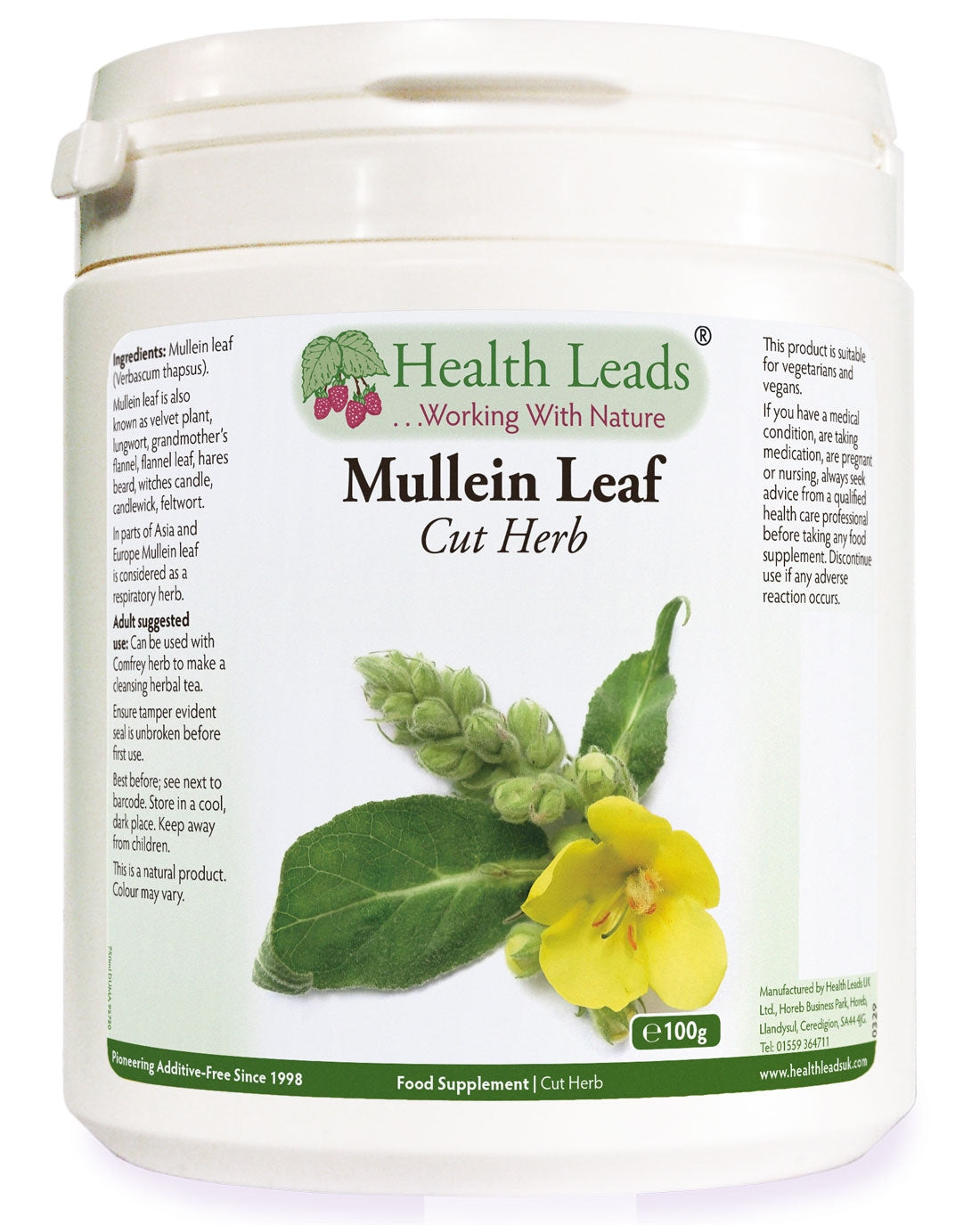
Health Leads Mullein Leaf is a cut dried leaf — the traditional format for preparing a herbal infusion. It is not powdered, encapsulated, or extracted. It is the dried leaf, cut for use as a tea.
To prepare:
- Place 1–2 teaspoons of cut Mullein Leaf into a cup or infuser
- Add freshly boiled water
- Allow to infuse for 10–15 minutes
- Strain carefully before drinking
Important — strain carefully. Mullein leaves have very fine natural hairs. These hairs can cause irritation to the throat if they pass through into the infusion. A fine mesh tea strainer or filter paper is strongly recommended — not just for a clearer infusion, but for comfort. This is not a minor detail. A standard tea strainer with large holes is not sufficient.
Mullein Leaf can also be blended with other herbs as part of a traditional herbal tea blend. It combines well with other botanicals used in respiratory-focused herbal traditions.
The infusion is naturally caffeine-free.
What to Expect From a Mullein Infusion
Mullein tea has a mild, slightly earthy flavour. It doesn't have the strong herbal bitterness of some botanicals — the taste is relatively gentle, which makes it easy to drink regularly.
The infusion has a slightly viscous quality when prepared correctly — a subtle thickness that reflects the mucilage content of the leaf. This is normal and expected.
It is not a strongly flavoured tea. Those looking for bold herbal character may find it mild. Those looking for a gentle, traditional herbal preparation that is easy to incorporate into a daily routine will find it well-suited to that purpose.
What's in Health Leads Mullein Leaf
The ingredient list is as short as it gets:
- 100% Cut Mullein Leaf (Verbascum thapsus) — 100g
- Other ingredients: None
No preservatives. No artificial colours. No flavourings. No additives of any kind. Suitable for vegetarians and vegans.
At £6.70 for 100g, it's also one of the more accessible botanicals in the range — a meaningful amount of leaf for daily infusion use over an extended period.
Made in Wales by Health Leads, a family business pioneering additive-free supplements since 1998. ISO accredited.
Who Should Exercise Caution
- Pregnant or breastfeeding women should consult their GP or midwife before using herbal products
- Anyone with a diagnosed respiratory condition should speak with their doctor before using Mullein or any herbal preparation in that context — it is not a treatment for asthma, COPD, or any other respiratory disease
- Anyone taking medication should check with their pharmacist before adding herbal infusions to their routine
- Discontinue use if you experience any adverse reaction
The Bottom Line
Mullein Leaf has one of the longer track records of any European botanical — documented in traditional herbal medicine for centuries across multiple cultures, consistently associated with respiratory comfort and throat soothing in traditional use.
The modern clinical evidence base is limited, and claims that circulate on social media about Mullein frequently go beyond what the evidence supports. It is a traditional herbal infusion, not a medicine, and should be understood in that context.
What it is: a well-characterised botanical with a coherent traditional use, a plausible mechanism, and a mild, accessible preparation that has been part of European herbal practice for a very long time. For those who find value in traditional herbal infusions and want a quality, additive-free source of Mullein Leaf, it's a straightforward choice.
Strain it carefully. Use a fine mesh or filter paper. That part matters.
Health Leads Mullein Leaf Cut 100g — 100% Verbascum thapsus, dried and cut. No additives, no preservatives, no flavourings. Naturally caffeine-free. Vegan. Made in Wales. ISO accredited. Additive-free since 1998. View product →