

Natural vs Synthetic Vitamin E: Why the Form You Take Actually Matters
Vitamin E is one of the most widely recognised antioxidant vitamins — found in most multivitamins, a common standalone supplement, and well-supported by decades of research. What's far less commonly understood is that not all Vitamin E supplements are the same form, and the difference between natural and synthetic Vitamin E is meaningful enough that it changes which product you should be buying.
This article explains what Vitamin E is, what it does, and why the distinction between natural D-Alpha Tocopherol and synthetic DL-Alpha Tocopherol matters more than most supplement labels make clear.
What Is Vitamin E?
Vitamin E is a fat-soluble vitamin — meaning it's absorbed alongside dietary fat and stored in fatty tissues and the liver rather than being excreted daily like water-soluble vitamins. It occurs naturally in foods including nuts, seeds, vegetable oils, avocado, and wheatgerm.
"Vitamin E" is not a single compound. It's a collective term for a family of eight related fat-soluble compounds — four tocopherols (alpha, beta, gamma, delta) and four tocotrienols (alpha, beta, gamma, delta). Of these, alpha-tocopherol is the form most actively maintained in human blood and tissues, and the form that has been most extensively studied in research.
Vitamin E has one EU-approved health claim: it contributes to the protection of cells from oxidative stress. That claim is well-supported. Vitamin E is a primary lipid-phase antioxidant — it protects cell membranes, which are made largely of fatty acids, from oxidative damage. This is a distinct and important role: whereas water-soluble antioxidants like Vitamin C operate in blood and cellular fluid, Vitamin E operates specifically within fatty environments — the cell membrane being the most critical of these.

Vitamin E occurs naturally in nuts, seeds, vegetable oils, avocado, and wheatgerm — all concentrated sources of natural D-Alpha Tocopherol.
Natural vs Synthetic Vitamin E — The Core Distinction
This is where most supplement buyers are either uninformed or actively misled by labelling.
Natural Vitamin E is labelled D-Alpha Tocopherol.
Synthetic Vitamin E is labelled DL-Alpha Tocopherol.
The difference between "D" and "DL" is not cosmetic. It reflects a fundamental difference in molecular structure.
D-Alpha Tocopherol is a single molecular form — the naturally occurring isomer that the human body recognises, transports, and utilises efficiently. It's the form found in food.
DL-Alpha Tocopherol is a mixture of eight different isomers produced through chemical synthesis. Only one of those eight isomers — the RRR form — matches the natural form. The other seven are synthetic stereoisomers that the body handles differently and less efficiently. The alpha-tocopherol transfer protein in the liver, which is responsible for incorporating Vitamin E into lipoproteins for transport around the body, has a strong preference for the natural RRR form and discriminates against the synthetic forms.
Research comparing natural and synthetic Vitamin E consistently shows that natural D-Alpha Tocopherol has significantly higher bioavailability — estimates typically range from 1.36 to 2 times more bioavailable than the equivalent dose of synthetic DL-Alpha Tocopherol. It also shows better tissue retention: natural Vitamin E is stored more effectively and remains in circulation longer.
In practical terms: if your supplement label says DL-Alpha Tocopherol, you are getting a mixture of forms the body uses inefficiently, at a dose that overstates its effective potency. If it says D-Alpha Tocopherol, you're getting the form the body actually uses.
The synthetic form is cheaper to produce, which is why it dominates mass-market multivitamins and lower-priced Vitamin E supplements. Natural D-Alpha Tocopherol costs more to source. That cost difference is real and reflects a real difference in quality.
What Does Non-Refined, Non-Deodorised Mean?
Health Leads Vitamin E goes a step further than simply using the natural form. The D-Alpha Tocopherol in our formula is sourced from non-refined and non-deodorised oils — a distinction that matters and that most supplement companies don't mention because most don't offer it.
Most vegetable oils used in food and supplement manufacturing undergo extensive commercial processing: refining, bleaching, and deodorising at high temperatures. These processes improve the oil's shelf life, neutralise flavour, and standardise colour — but they also remove or degrade naturally occurring compounds present in the original oil, including minor tocopherols, phytosterols, and other plant-derived components.
By sourcing Vitamin E from non-refined, non-deodorised oils, Health Leads preserves more of the natural characteristics of the source material. The result is a less processed ingredient that more closely reflects what you'd find in whole food sources of Vitamin E.
This is not a marketing claim dressed up as a feature. It's a genuine formulation choice that adds cost and complexity to sourcing, and that results in a meaningfully less processed product.
What Vitamin E Does — and What the Evidence Supports
Established — EU health claim approved:
- Vitamin E contributes to the protection of cells from oxidative stress. This is the primary, well-evidenced function — Vitamin E is the body's main fat-soluble antioxidant, protecting cell membranes from lipid peroxidation.
Well-supported by research:
- Immune function — Vitamin E supports normal immune cell function; deficiency impairs both innate and adaptive immune responses
- Skin health — Vitamin E is present in skin tissue and sebum; it plays a role in maintaining skin barrier integrity and protecting against UV-induced oxidative damage
- Eye health — Vitamin E, particularly in combination with other antioxidants, has been studied in the context of age-related eye health
- Antioxidant network — Vitamin E works synergistically with Vitamin C; oxidised Vitamin E (tocopheroxyl radical) is regenerated back to active form by Vitamin C, which is why the two are commonly taken together
Overclaimed or insufficiently evidenced:
- High-dose Vitamin E for cardiovascular disease prevention — large trials including HOPE and GISSI have not demonstrated benefit, and some suggested potential harm at very high doses in specific populations. Supplementation at standard doses as part of a balanced diet is a different context to high-dose therapeutic use.
- Vitamin E as a standalone anti-ageing treatment — the evidence for topical use in skincare is mixed; for oral supplementation the case for direct cosmetic benefit is weaker than marketing often implies
Important: Vitamin E and Blood Thinners
This is a safety point that needs to be stated clearly, not buried in small print.
Vitamin E has mild anticoagulant properties — it can inhibit platelet aggregation and at higher doses may enhance the effect of anticoagulant medications including warfarin. If you are taking warfarin, any other blood-thinning medication, or antiplatelet drugs, do not take Vitamin E supplements without consulting your doctor or pharmacist first.
The same applies if you are due to undergo any surgical procedure — Vitamin E supplementation is typically recommended to be paused before surgery due to its effect on bleeding time.
At standard supplemental doses of 400 IU in otherwise healthy individuals not taking these medications, Vitamin E has a strong safety record. The caution applies specifically to those on anticoagulant therapy.
How to Take Vitamin E
Vitamin E is fat-soluble. This is not a minor technical detail — it directly affects how well it's absorbed.
Taking Vitamin E with a meal that contains some dietary fat will significantly improve absorption compared to taking it on an empty stomach or with a fat-free meal. A small amount of fat is sufficient — a handful of nuts, some avocado, olive oil in a meal. It doesn't need to be a large or fatty meal, just not a fat-free one.
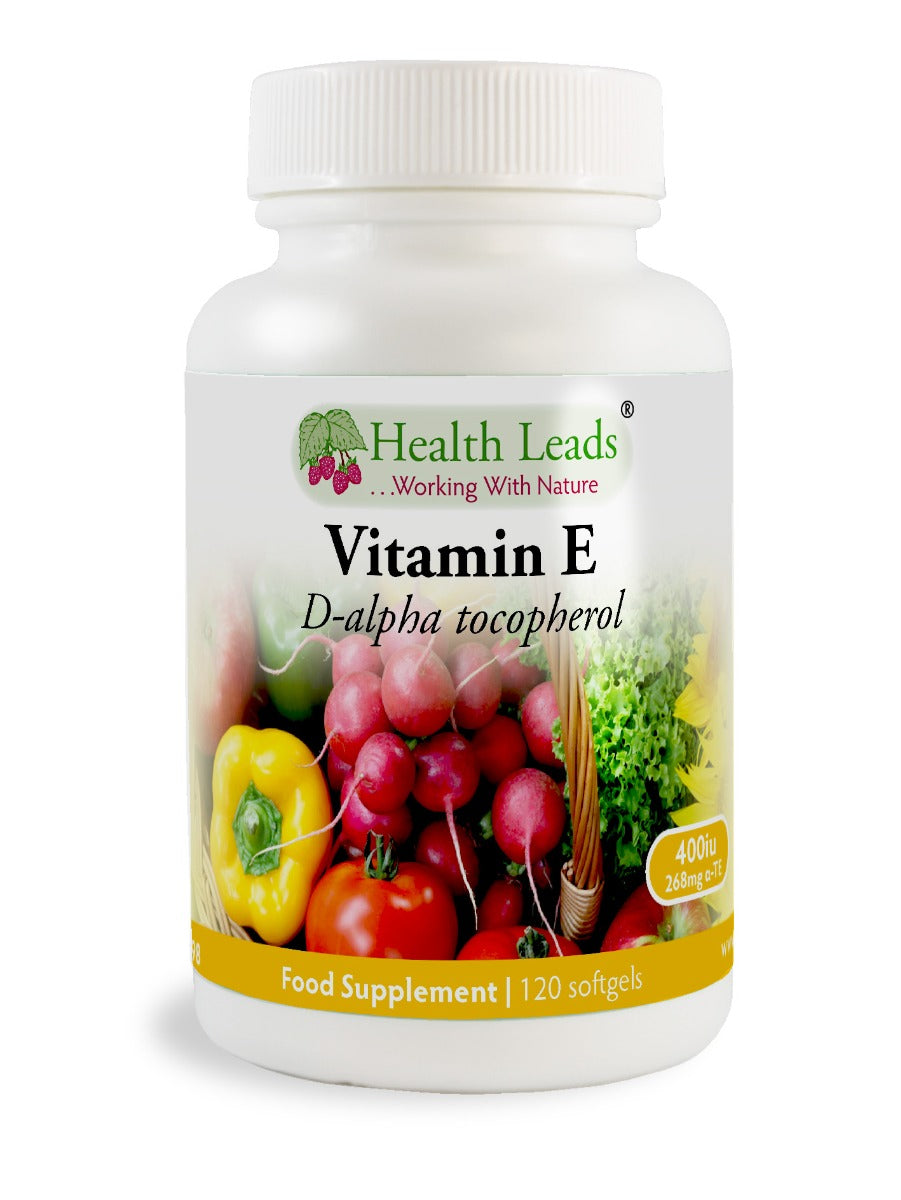
The suggested intake for Health Leads Vitamin E is one capsule daily, providing 400 IU (268mg) of natural D-Alpha Tocopherol. At one capsule per day, a single 120-capsule bottle provides a 120-day supply at £0.12 per capsule.
Vitamin C is the natural complement to Vitamin E in the body's antioxidant network — the two vitamins work together in a cycle where Vitamin C regenerates oxidised Vitamin E back to its active form. Taking both as part of a broader antioxidant approach is well-supported by the underlying biochemistry.
What's in Health Leads Vitamin E 400 IU
Each capsule contains:
- Natural Source Vitamin E (D-Alpha Tocopherol) — 400 IU (268mg)
- Natural vegetable oil (carrier)
- Bovine gelatin capsule shell
- Other ingredients: None
No magnesium stearate. No artificial colours. No artificial sweeteners. No unnecessary fillers.
Important — not suitable for vegetarians or vegans. The capsule shell is bovine gelatin. This is clearly stated on the label and product page. If you require a vegan or vegetarian Vitamin E supplement, this product is not appropriate for you.
Made in Wales by Health Leads, ISO accredited, additive-free since 1998.
Natural vs Synthetic at a Glance
| Natural D-Alpha Tocopherol | Synthetic DL-Alpha Tocopherol | |
|---|---|---|
| Label identifier | D-Alpha Tocopherol | DL-Alpha Tocopherol |
| Molecular forms | Single natural isomer (RRR) | Mix of 8 isomers, only 1 matches natural |
| Bioavailability | Higher — body preferentially absorbs and retains | Lower — synthetic isomers handled less efficiently |
| Tissue retention | Better — stored and circulated more effectively | Poorer — synthetic forms cleared faster |
| Source | Derived from plant oils | Chemically synthesised |
| Cost | Higher | Lower |
| Health Leads product | Yes — non-refined, non-deodorised source | No |
The Bottom Line
Vitamin E is a well-established antioxidant vitamin with a clear, EU-approved role in protecting cells from oxidative stress. The evidence base is solid, the mechanism is well understood, and it's a rational supplement for anyone looking to support their antioxidant defences.
What most people don't know when they buy Vitamin E is that the form matters significantly. Natural D-Alpha Tocopherol is more bioavailable, better retained in tissue, and more closely reflects the form found in food than synthetic DL-Alpha Tocopherol — which dominates the mass market precisely because it's cheaper to produce.
Check the label on your current Vitamin E supplement. If it says DL-Alpha, you're getting the synthetic mixture. If it says D-Alpha, you're getting the natural form.
The warfarin interaction is real and worth checking with your doctor if relevant. The fat absorption point is practical and worth following. Everything else is straightforward.
Health Leads Vitamin E 400 IU — natural D-Alpha Tocopherol from non-refined, non-deodorised oils. 120 capsules, 120-day supply, £0.12 per capsule. No magnesium stearate, no artificial additives. Made in Wales. ISO accredited. Additive-free since 1998. Not suitable for vegetarians or vegans. View product →