

Uva Ursi (Bearberry): What It Is and How It's Traditionally Used
If you've found your way to Uva Ursi, you're almost certainly researching it for one specific reason: urinary health. That's not a coincidence — Uva Ursi has been used in traditional European herbal medicine for this purpose for centuries, and it remains one of the most consistently searched botanicals in the urinary support category.
This article explains what Uva Ursi is, what its key plant compounds are, what the traditional use context looks like, what the evidence supports, and — critically — what the limitations and safety considerations are. The short-term use requirement in particular is not a small print detail. It's central to using this botanical appropriately.
What Is Uva Ursi?
Uva Ursi (Arctostaphylos uva-ursi) is a small evergreen shrub found across Europe, Asia, and North America. Its common name, Bearberry, reflects the fact that bears were observed eating the red berries of the plant — though it's the leaves, not the berries, that are used in herbal preparations.
It's a hardy, low-growing plant found at altitude, in rocky terrain, and in woodland environments. The leaves are dark green, leathery, and small — and it's these dried leaves that have been used in traditional herbal medicine for well over a millennium. References to Uva Ursi leaf preparations appear in European herbal texts from as far back as the 13th century.

Arctostaphylos uva-ursi — Bearberry — a low-growing evergreen shrub whose leaves have been used in traditional herbal preparations for centuries.
What's in the Leaf?
Uva Ursi leaves contain a characteristic set of plant compounds that distinguish them from other botanicals and underpin their traditional use:
- Arbutin — a glycoside compound that is the primary active constituent of Uva Ursi leaf. When ingested, arbutin is hydrolysed in the gut and converted to hydroquinone, which is then excreted through the kidneys via the urine. In an alkaline urinary environment, hydroquinone has demonstrated antimicrobial properties in laboratory research. This proposed mechanism is the basis for Uva Ursi's traditional application.
- Tannins — astringent plant compounds with antioxidant properties, present in relatively high concentrations in Uva Ursi leaf. Tannins contribute to the botanical's traditional profile and are partly responsible for its characteristic bitter taste.
- Flavonoids — including quercetin and hyperoside, naturally occurring plant pigments with antioxidant properties.
- Allantoin — a compound also found in comfrey, associated with soothing properties in traditional use.
The arbutin content is the defining characteristic. Uva Ursi leaves typically contain 5–15% arbutin by dry weight — one of the higher natural concentrations of this compound in any plant.
Traditional Use and the Urinary Context
The traditional use of Uva Ursi leaf is specifically associated with the urinary tract. It has been used in European herbal medicine for centuries as a botanical preparation taken during periods of urinary discomfort — particularly the kind of symptoms associated with lower urinary tract irritation: frequent urination, burning sensation, discomfort.
This context is important to understand clearly. Uva Ursi is a traditional herbal preparation with a centuries-long track record of use for urinary symptoms. It is not a treatment for urinary tract infections (UTIs), which are bacterial infections requiring diagnosis and — where indicated — antibiotic treatment.
Anyone experiencing symptoms of a UTI — particularly fever, back or flank pain, blood in the urine, or symptoms that are severe or worsening — should seek medical assessment promptly. Uva Ursi is not a substitute for medical care in these situations.
What the Evidence Shows
Well-characterised:
- The arbutin content of Uva Ursi leaf is well-documented and consistently measured
- The conversion of arbutin to hydroquinone in the gut and subsequent renal excretion is established pharmacokinetics
- Hydroquinone has demonstrated antimicrobial properties in laboratory (in vitro) studies
- The proposed mechanism is coherent and biologically plausible
Where the evidence is limited:
- Clinical trial data specifically on Uva Ursi leaf preparations in humans is limited in both quantity and quality
- The in vitro antimicrobial activity of hydroquinone does not automatically translate to equivalent clinical outcomes — laboratory findings and human trial outcomes are different things
- There are no EU-approved health claims for Uva Ursi relating to urinary health
Uva Ursi has a Traditional Herbal Medicinal Product (THMP) registration in some European countries for use in minor urinary complaints. In the UK, this registration framework exists under the MHRA. This represents a regulatory acknowledgement of its traditional use, not an approval based on clinical trial evidence comparable to pharmaceutical standards.
The honest summary: Uva Ursi has a long, consistent, and well-documented history of traditional use for urinary symptoms. The proposed mechanism is scientifically plausible. The clinical evidence base is limited but not absent. It should be understood as a traditional botanical with a coherent rationale — not as a proven pharmaceutical-grade treatment.
The Short-Term Use Requirement — This Matters
This is the most important safety consideration with Uva Ursi and the one most frequently under-emphasised in general content about it.
Uva Ursi is suitable for short-term use only.
The standard guidance is use for up to two weeks, followed by a break. It should not be taken continuously or as a long-term daily supplement.
The reason is the hydroquinone content. While hydroquinone at low concentrations is the proposed active component in urinary excretion, it is a compound with known toxicity concerns at higher exposures and with chronic use. Long-term or excessive intake of hydroquinone-generating compounds carries potential risks that are not present with short-term use at recommended doses.
This is not a hypothetical caution added out of regulatory conservatism. It is a genuine safety consideration that should govern how Uva Ursi is used. If you are considering using Uva Ursi repeatedly over an extended period, seek advice from a qualified healthcare professional.
Who Should Not Take Uva Ursi
- Pregnant or breastfeeding women — Uva Ursi is not suitable during pregnancy or breastfeeding. This is a firm contraindication, not a precautionary note.
- Anyone with kidney disease — the renal excretion of hydroquinone places additional demands on kidney function; those with existing kidney conditions should consult their doctor before use
- Children — not suitable for children
- Anyone taking prescription medication — consult your pharmacist before use
- Anyone with symptoms suggesting an upper urinary tract infection (fever, back pain, rigors, blood in urine) — seek medical assessment immediately rather than self-treating with herbal preparations
An Important Note on Urinary pH
The proposed antimicrobial activity of hydroquinone (from arbutin conversion) is pH-dependent — it is more active in an alkaline urinary environment. An acidic diet, or the consumption of acidic substances including high doses of Vitamin C, may reduce the urinary pH and theoretically reduce efficacy.
Some traditional Uva Ursi protocols specifically recommend avoiding large quantities of acidic foods and beverages during use for this reason. This is worth being aware of, though the clinical evidence for this dietary modification specifically is limited.
Whole Leaf vs Extract
Health Leads Uva Ursi uses whole powdered leaf rather than a standardised extract. This is worth explaining because it's a genuine formulation difference.
Standardised extracts concentrate a specific compound — usually arbutin — to a defined percentage per dose. Whole leaf powder retains the complete botanical profile: arbutin, tannins, flavonoids, and all other naturally occurring compounds in the proportions found in the plant.
Neither approach is categorically superior — they represent different philosophies. Extracts offer dose precision for a single constituent; whole leaf preparations preserve the full complement of plant compounds in their natural ratios, which is consistent with how the botanical has been used in traditional herbal practice.
Health Leads uses whole leaf powder as a commitment to presenting the botanical in its traditional form.
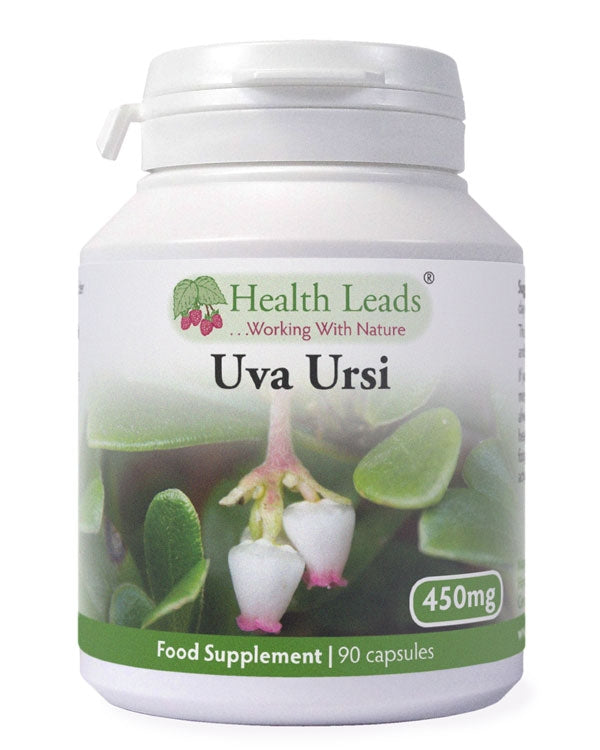
What's in Health Leads Uva Ursi 450mg
Each capsule contains:
- Uva Ursi Leaf Powder (Arctostaphylos uva-ursi) — 450mg
- HPMC vegetable capsule shell
- Other ingredients: None
No magnesium stearate. No fillers. No binders. No artificial colours or sweeteners. Suitable for vegetarians and vegans.
Suggested use: 2 capsules twice daily with food (1800mg per day total). At this intake, a 90-capsule pack provides approximately 22 days' supply — consistent with the short-term use approach appropriate for this botanical.
Commonly taken alongside Dandelion Leaf, which is used traditionally as a natural diuretic to support fluid throughput.
Made in Wales by Health Leads, ISO accredited, additive-free since 1998. £10.30 per pack / £0.11 per capsule.
The Bottom Line
Uva Ursi has one of the more coherent traditional use cases in the herbal supplement category. The botanical is well-characterised, the active compound is identified, the proposed mechanism is biologically plausible, and the history of use is long and consistent across multiple cultures and centuries.
The clinical evidence base is limited relative to pharmaceutical standards — this is true of most traditional botanicals and should be acknowledged rather than glossed over. The traditional use designation reflects this honestly.
The short-term use requirement is the non-negotiable aspect of using Uva Ursi appropriately. Up to two weeks, then a break. Not a long-term supplement, not a daily addition to a wellness stack. Used within those parameters, it is a well-understood traditional botanical with a specific, rational application.
If you are experiencing urinary symptoms, particularly severe or worsening symptoms, fever, or any indication of upper urinary tract involvement — see a doctor. No herbal preparation is a substitute for that assessment.
Health Leads Uva Ursi 450mg — pure Arctostaphylos uva-ursi whole leaf powder. No magnesium stearate, no fillers, no artificial additives. HPMC vegan capsule. 90 capsules / 22-day supply at recommended intake. Made in Wales. ISO accredited. Additive-free since 1998. Short-term use only. View product →