

Activated Charcoal — What It Is, Food Grade Quality and How to Use It
Activated charcoal has one of the more colourful reputations in the supplement category. Search for it online and you'll find confident claims about detoxification, hangover prevention, teeth whitening, kidney support, and general "cleansing." You'll also find black lattes, black ice cream, and black bread that have very little to do with any of the above.
The reality is more specific — and more interesting — than either the hype or the scepticism suggests. Activated charcoal does one thing exceptionally well, supported by both an EU-approved health claim and a clinical track record. What it doesn't do is most of what it's marketed for.
This article gives you the accurate picture.
What Is Activated Charcoal?
Activated charcoal is not the same as charcoal from a barbecue, fireplace, or pencil. It's a processed form of carbon — typically derived from coconut shells, wood, or coal — that has been treated with high temperatures and oxidising gases to create an extraordinarily porous internal structure.
The result is a material with a massive surface area relative to its volume. A single gram of activated charcoal can have a surface area exceeding 1,000 square metres — the equivalent of roughly two tennis courts, in a quantity smaller than your thumbnail. This surface area is what gives activated charcoal its defining property: adsorption.
Adsorption (not absorption — the distinction matters) is the process by which molecules adhere to the surface of a material rather than being absorbed into it. Activated charcoal doesn't chemically react with substances — it physically binds them to its surface, trapping them and carrying them through the digestive tract.
Health Leads uses activated charcoal derived from coconut shells (Cocos nucifera) — a cleaner, food-grade source material compared to wood-based or coal-derived activated charcoal, and the preferred form for supplement use.

Health Leads Activated Charcoal is produced from coconut shells — a food-grade source material with a large, highly porous surface area.
The One Thing Activated Charcoal Is Proven to Do
There is one EU-approved health claim for activated charcoal, and it's specific:
Activated charcoal contributes to reducing excessive flatulence after eating.
The beneficial effect is obtained with 1g taken at least 30 minutes before a meal and 1g taken shortly after the meal.
This is the claim that has gone through European Food Safety Authority (EFSA) scrutiny and been approved based on the available evidence. It's narrow, but it's real — and it reflects the underlying mechanism accurately. Gas produced during digestion — from fermentation of undigested carbohydrates by gut bacteria — can be adsorbed to the surface of activated charcoal before it builds up, reducing bloating and flatulence.
For people who experience significant post-meal bloating or excess gas — whether from specific foods, digestive sensitivity, or gut dysbiosis — this is a legitimate and well-supported application.
What About the Other Claims?
This is where most activated charcoal content diverges from the evidence. Worth being direct about each:
Detoxification and "cleansing"
Activated charcoal does bind to certain substances in the digestive tract. This property is used clinically in cases of poisoning — hospital-grade activated charcoal is administered to bind to ingested toxins before they are absorbed into the bloodstream, and this use is well-evidenced.
However, this clinical application bears very little resemblance to the "daily detox" use case marketed to supplement buyers. The body has its own highly effective detoxification systems — primarily the liver and kidneys. Taking activated charcoal as a daily supplement to "remove toxins" is not supported by evidence and misrepresents how both activated charcoal and the body's detoxification systems actually work.
Hangover prevention
Activated charcoal does not adsorb ethanol (alcohol) effectively. The two are simply not a good chemical match — alcohol passes through without significant binding. The widespread claim that activated charcoal helps prevent or treat hangovers is not supported by evidence.
Teeth whitening
Activated charcoal toothpastes and powders are widely marketed. The evidence base is weak and the safety picture is unclear — the abrasive nature of charcoal may damage enamel with regular use. This is a topical application entirely separate from oral supplementation and is outside the scope of food supplement use.
Kidney support, cholesterol reduction, and other systemic effects
There is limited and inconclusive research in some of these areas. None have resulted in approved health claims. They should be treated as unproven at this stage.
The honest position: activated charcoal works mechanically in the gut. What it binds to there has genuine implications for digestive gas. Claims about systemic effects — things that happen after absorption into the bloodstream — are largely not supported, because activated charcoal doesn't get absorbed into the bloodstream. It travels through the gut and exits the body.
The Most Important Thing to Know: It Binds to Everything
The adsorptive properties of activated charcoal are non-selective. It doesn't distinguish between substances it should bind to and substances it shouldn't. This has one critical practical implication:
Activated charcoal can significantly reduce the absorption of medications and other supplements taken at the same time.
This is not a theoretical concern. It is a well-documented pharmacological interaction. Activated charcoal is used clinically precisely because of this effect — to prevent absorption of ingested substances. When taken alongside medications, it can reduce their bioavailability substantially.
The standard guidance is to take activated charcoal at least two hours before or after any medication or other food supplement. If you take prescription medication — particularly time-sensitive medication where consistent blood levels matter — consult your doctor or pharmacist before using activated charcoal.
For the same reason, NAC and activated charcoal should not be taken together — activated charcoal will bind to NAC and reduce its absorption.
One more practical point worth knowing upfront: activated charcoal will turn your stools black. This is completely normal and is simply the charcoal passing through. It is not a cause for concern, but it's worth knowing before it happens rather than after.
Capsules vs Powder — Which Format Is Right for You?
Health Leads offers activated charcoal in two formats. The choice depends on how you intend to use it.
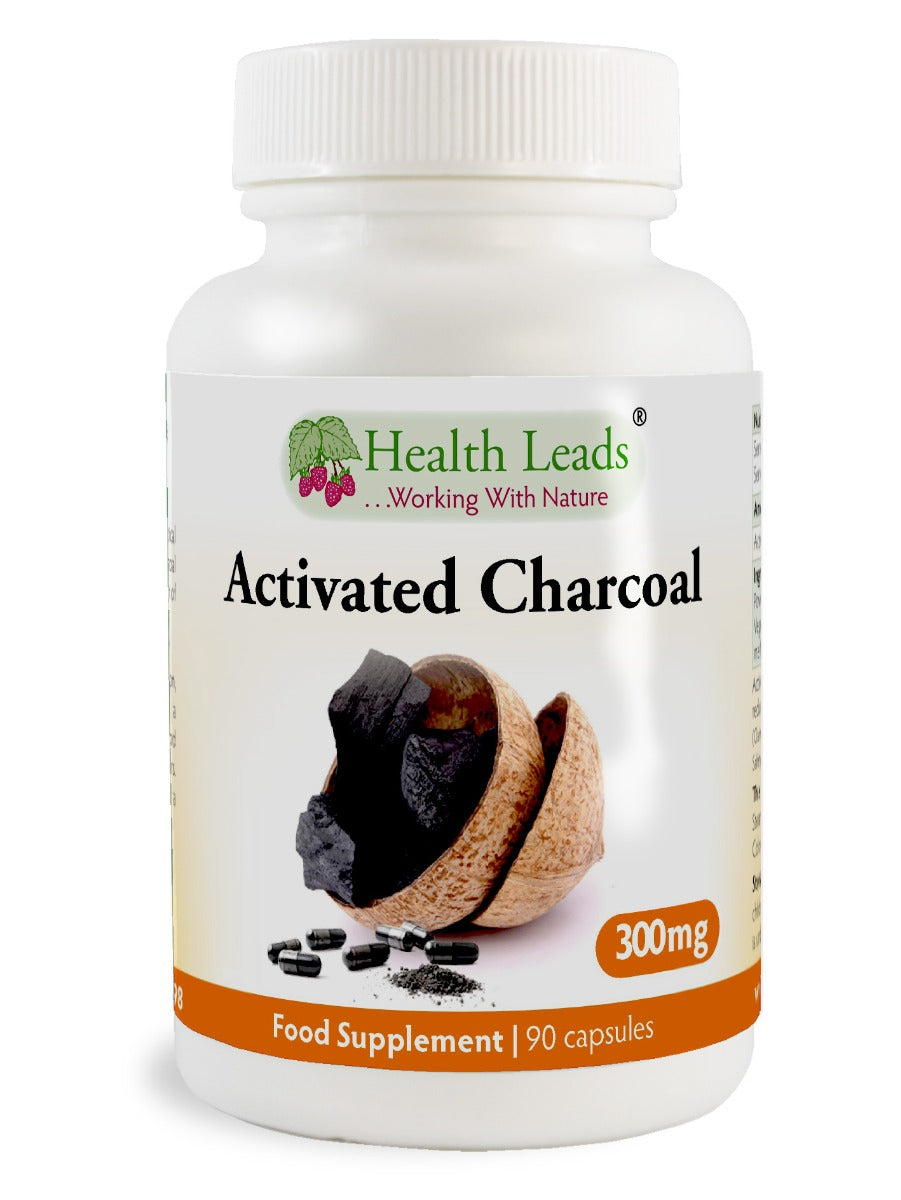
Activated Charcoal 300mg x 90 Capsules — £9.90
Each HPMC vegetable capsule contains 300mg of activated charcoal from coconut shell. No fillers, no flow agents — just charcoal in a vegan capsule shell.
Suggested use: 2 capsules before a meal, 2 capsules after a meal (providing 600mg per serving, twice daily).
The capsule format is the more convenient option for everyday use. Pre-measured doses, easy to take with water, no mess, no measuring. Suitable for those who want a straightforward, portable option.
90 capsules — £0.11 per capsule
View Activated Charcoal Capsules →
Activated Charcoal Powder 200g — £12.70
Pure activated charcoal powder from coconut shell with zero other ingredients. Supplied with a measuring scoop (1ml, approximately 500mg per level scoop).
Suggested use: 1g (2 level scoops) at least 30 minutes before a meal and 1g shortly after the meal — the precise protocol that corresponds to the EU-approved health claim for flatulence reduction.
The powder format allows flexible dosing and is a more cost-effective option per gram of charcoal. It can be mixed into water or juice. The taste is minimal — activated charcoal has very little flavour — but the texture is gritty and the resulting drink will be black. Stir well and drink promptly before it settles.
A note on handling: take care when measuring to avoid creating airborne dust. Do not inhale the powder.
200g — flexible dosing
View Activated Charcoal Powder →
What's in Both Products
| Capsules 300mg x 90 | Powder 200g | |
|---|---|---|
| Active ingredient | Activated Charcoal (Coconut Shell) 300mg | Activated Charcoal (Coconut Shell) 200g |
| Other ingredients | HPMC vegetable capsule — nothing else | None |
| Fillers / flow agents | None | None |
| Vegan | Yes | Yes |
| Source material | Coconut shell | Coconut shell |
| Measuring scoop | Not needed — pre-measured | Included |
| Price | £9.90 (£0.11 per capsule) | £12.70 |
Both are made in Wales by Health Leads, ISO accredited, additive-free since 1998.
The Bottom Line
Activated charcoal is a well-understood compound with one clear, evidence-backed application in supplement use: reducing excessive flatulence after eating. The mechanism is real, the EU health claim is legitimate, and the timing protocol is specific.
Most of the other things it's marketed for — detoxification, hangover prevention, systemic cleansing — are not supported by the evidence to a standard that has resulted in any approved health claim. This doesn't mean activated charcoal is ineffective; it means its effectiveness is specific to what it actually does in the gut, which is adsorb substances it comes into contact with before they pass further through the digestive tract.
The medication interaction point is the one that requires genuine attention. Two hours either side of any medication or supplement, without exception. Everything else is straightforward — including the black stools, which are normal and temporary.
Health Leads Activated Charcoal — pure coconut shell activated charcoal, available as 300mg capsules (90-day supply, £9.90) or 200g powder (£12.70). No fillers. No additives. Vegan. Made in Wales. ISO accredited. Additive-free since 1998.