

Slippery Elm: What It Is and How It's Used
Slippery Elm is one of the older entries in the herbal supplement category — used in traditional North American herbalism for centuries before it found its way into modern supplement ranges. It's not a new discovery dressed up in contemporary wellness language. It's a well-characterised botanical with a specific and unusual property that makes it genuinely distinct from most other herbal powders.
This article explains what Slippery Elm is, what makes it interesting from a biological standpoint, how it's traditionally been used, and what the current evidence supports.
What Is Slippery Elm?
Slippery Elm (Ulmus rubra) is a species of elm tree native to North America, found predominantly in the eastern United States and southern Canada. The supplement comes from the inner bark of the tree — not the outer bark, which is discarded — which is dried and milled into a fine powder.

The name comes from the texture of the inner bark when it makes contact with water. It becomes noticeably slick — slippery — due to the presence of a class of plant compounds called mucilage.
What Is Mucilage and Why Does It Matter?
Mucilage is a group of complex polysaccharides — long-chain carbohydrate molecules — found in various plants. What makes mucilage distinctive is its behaviour in water: it absorbs liquid and swells, forming a thick, viscous, gel-like substance.
This isn't unique to Slippery Elm — mucilage is found in other botanicals including marshmallow root, flaxseed, and aloe vera — but Slippery Elm inner bark is among the more concentrated natural sources.
When Slippery Elm powder is mixed with water and consumed, the mucilage forms a gel that coats the surfaces it comes into contact with as it moves through the digestive tract. This coating property is the basis for most of its traditional uses.

Slippery Elm inner bark powder — the mucilage it contains forms a natural gel when mixed with water.
Traditional Uses
Slippery Elm has a long history of use in Native American traditional medicine, where the inner bark was used both internally and externally. Internally, it was prepared as a gruel or porridge — mixed with water to form a thick, nourishing paste — and used to soothe the digestive tract, particularly during illness or periods of digestive sensitivity.
It was also historically used as a food source. The mucilaginous paste is calorie-dense and easy to digest, making it a practical option during illness when normal food was poorly tolerated. In the 19th century it was widely used in European and North American herbal medicine and was listed in the United States Pharmacopeia from 1820 to 1960.
Today its use is concentrated in the digestive health category, where people use it primarily for its soothing, coating properties in the gut.
How Slippery Elm Is Used Today
The contemporary use of Slippery Elm centres on digestive comfort. People who use it typically fall into one of a few groups:
- Those with irritable bowel syndrome (IBS) — Slippery Elm is one of the more commonly used herbal supplements among people managing IBS symptoms, particularly those with a pattern that alternates between constipation and diarrhoea. The mucilage may help normalise stool consistency — adding bulk when loose and softening when hard.
- Those with inflammatory bowel conditions — some people with Crohn's disease or ulcerative colitis use Slippery Elm as a complementary approach alongside conventional management. This is an area where medical supervision is important — it is not a treatment for these conditions.
- Those experiencing general digestive sensitivity — bloating, discomfort, a sense of irritation in the gut — Slippery Elm is used by people looking for a gentle, food-grade approach to calming an unsettled digestive tract.
- Those with throat or oesophageal irritation — the coating effect of mucilage extends to the upper digestive tract. Slippery Elm has historically been used to soothe the throat and oesophagus, and some people use it in this context today.
What Does the Evidence Say?
Slippery Elm sits in the traditional herbal medicine category, which means the evidence base is thinner than for pharmaceutical interventions but not absent.
What is well-established:
- The mucilage in Slippery Elm inner bark is a real, well-characterised compound with measurable water-absorbing and gel-forming properties
- The coating mechanism is biologically plausible — mucilage does form a gel that lines mucosal surfaces
- It has a long, documented history of use across multiple cultures and was included in official pharmacopeias for over a century
Where the evidence is more limited:
- Large-scale randomised controlled trials on Slippery Elm specifically are limited
- Most clinical research involves it as part of herbal combinations rather than as a standalone ingredient, making it difficult to attribute effects to Slippery Elm alone
- The mechanisms are plausible and the traditional evidence is substantial, but the modern clinical evidence base is not yet at the level of pharmaceutical research
The honest position: Slippery Elm is a well-understood botanical with a coherent mechanism and a centuries-long track record of use. It is not a treatment for diagnosed gastrointestinal conditions. It is a food supplement with a specific, rational application in digestive comfort.
An Important Caution: Timing with Medications
This is worth highlighting clearly because it's often missed in general articles about Slippery Elm.
The same mucilage that gives Slippery Elm its soothing properties can also coat the lining of the digestive tract in a way that impairs the absorption of other substances — including medications and other supplements taken at the same time.
If you take any prescription medication — particularly time-sensitive medication where consistent absorption matters — you must consult your doctor or pharmacist before using Slippery Elm. The standard guidance is to take Slippery Elm well away from any other medication or supplement, with a gap of at least two hours on either side.
This is not a minor footnote. It is a clinically relevant interaction that should be taken seriously.
How to Prepare Slippery Elm Powder
Slippery Elm powder doesn't dissolve in water the way a standard supplement powder would. The preparation process is straightforward but takes some patience:
- Add approximately 80ml of water to ½ teaspoon of Slippery Elm Bark Powder
- Stir thoroughly to combine — the mixture will initially appear lumpy
- Allow the mixture time to thicken — this can take between 1 and 5 hours as the mucilage absorbs the water and develops a smoother, gel-like consistency
A practical approach used by many people is to prepare the mixture before bedtime and leave it overnight, ready to take the following morning. The consistency can be adjusted by varying the amount of water used — more water for a thinner preparation, less for a thicker one.
Suggested intake is ½ to 2 teaspoons up to three times daily. Start at the lower end to assess your individual response.
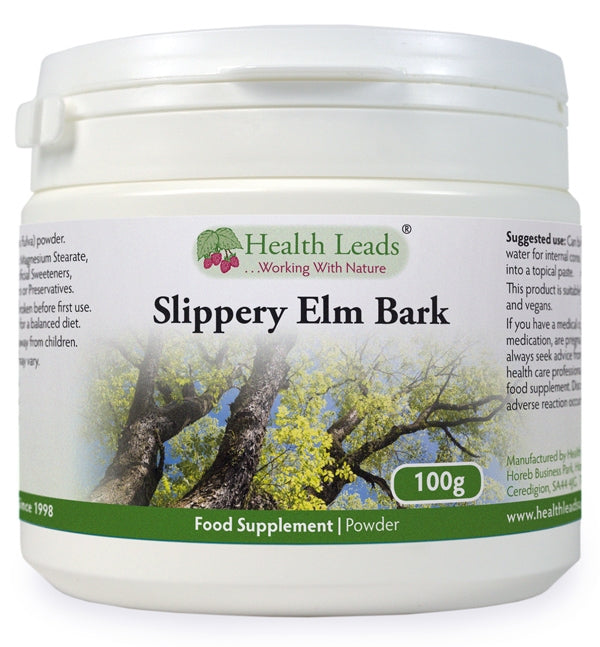
What's in Health Leads Slippery Elm Powder
The ingredient list for Health Leads Slippery Elm Powder is short by design:
- Slippery Elm Inner Bark Powder (Ulmus rubra) — 100g
- Other ingredients: None
No magnesium stearate. No fillers. No binders. No flow agents. No artificial colours or sweeteners. Just finely milled Slippery Elm inner bark. Suitable for vegans and vegetarians.
This matters because powders in particular are prone to adulteration with bulking agents — maltodextrin, rice flour, or other fillers that increase volume without adding any active ingredient. With a single-ingredient product, what's on the label should be the entirety of what's in the container. At Health Leads, it is.
Made in Wales. ISO accredited. Additive-free since 1998.
Who Should Not Use Slippery Elm
- Anyone taking prescription medication should consult their doctor or pharmacist first — the mucilage absorption issue is significant
- Pregnant or breastfeeding women should seek professional advice before use
- Anyone with a diagnosed gastrointestinal condition should discuss use with their healthcare provider before starting
- If you experience any adverse reaction, discontinue use and seek advice
The Bottom Line
Slippery Elm is one of the more genuinely distinctive botanicals in the supplement category — its mucilage content gives it a specific, measurable property that most herbal supplements simply don't have. The mechanism is real, the history of use is long and well-documented, and its application in digestive comfort is rational and coherent.
It is not a treatment for any diagnosed condition. The clinical evidence base is limited compared to pharmaceutical standards. But as a food supplement with a specific, well-understood mode of action, it occupies a reasonable and distinct position in the digestive health category.
The timing caution around medications is the one aspect that requires genuine care — it should not be overlooked.
Health Leads Slippery Elm Powder — 100g of pure Slippery Elm inner bark (Ulmus rubra). No fillers, no additives, no other ingredients. Vegan. Made in Wales. ISO accredited. Additive-free since 1998. View product →