

What Is Betaine HCl and Do You Need It?
Betaine HCl is one of those supplements that sits quietly in the digestive health category, rarely marketed aggressively, but searched for consistently by people who've done their homework and arrived at a specific question: is my stomach acid low, and would this help?
It's a reasonable question. This article answers it directly — what Betaine HCl is, how it works, who it's genuinely relevant for, and what the evidence does and doesn't support.
What Is Betaine HCl?
Betaine HCl (Betaine Hydrochloride) is a compound that provides a source of hydrochloric acid. Hydrochloric acid — HCl — is the acid your stomach produces naturally as part of the digestive process. It's a normal and essential component of gastric fluid.
When you take Betaine HCl as a supplement, it dissociates in the stomach to release hydrochloric acid, temporarily lowering gastric pH — in other words, increasing stomach acidity.
Betaine itself (trimethylglycine) is a naturally occurring compound found in foods like beetroot, spinach, and wholegrains. In Betaine HCl, it acts as the delivery vehicle for the hydrochloric acid component.
Why Does Stomach Acid Matter?
This is where most people's understanding starts to shift. We're culturally conditioned to think of stomach acid as something to reduce — antacids are one of the most commonly purchased over-the-counter products in the UK. The assumption is that stomach problems are caused by too much acid.
For a portion of the population — those with gastritis, peptic ulcers, or acid reflux — that framing is correct. Excess acid is a genuine problem and needs to be addressed.
But for another group, the issue runs in the opposite direction. Adequate stomach acid is necessary for:
- Protein digestion — HCl activates pepsin, the enzyme responsible for breaking down dietary protein. Without sufficient acid, pepsin doesn't activate properly and protein is not adequately digested.
- Nutrient absorption — Several key micronutrients require an acidic gastric environment for proper absorption. These include vitamin B12, iron, zinc, magnesium, and calcium. Low stomach acid is associated with poor absorption of all of these.
- Pathogen defence — The stomach's acidic environment acts as a barrier against ingested pathogens. A less acidic stomach is a less effective filter.
- Triggering downstream digestion — Adequate gastric acidity signals the release of digestive enzymes from the pancreas and bile from the gallbladder. Low acid can impair the entire downstream digestive cascade.

Stomach acid isn't just about digestion — it triggers a cascade of processes further down the digestive tract.
What Is Hypochlorhydria?
Hypochlorhydria is the clinical term for low stomach acid production. It's distinct from achlorhydria, which is a complete absence of stomach acid — a more severe and less common condition.
Stomach acid production naturally declines with age. Research suggests that a significant proportion of people over 60 have measurably reduced gastric acid secretion compared to younger adults — though the extent varies considerably between individuals.
Other factors associated with reduced stomach acid production include:
- Long-term use of proton pump inhibitors (PPIs) such as omeprazole or lansoprazole
- H2 blocker medications (ranitidine, famotidine)
- Chronic stress — which can suppress gastric acid secretion via the nervous system
- Helicobacter pylori infection — a common bacterial infection that can damage acid-producing cells in the stomach lining
- Thyroid disorders, particularly hypothyroidism
- Nutrient deficiencies, particularly zinc (which is required for HCl production)
It's worth noting: many of the symptoms associated with low stomach acid overlap significantly with symptoms of high stomach acid — bloating, belching, discomfort after meals, a feeling of food sitting heavily. This overlap is one reason the condition is frequently misidentified and why antacids are often taken by people who may actually have the opposite problem.
Signs That Stomach Acid May Be Low
There is no straightforward at-home test for stomach acid levels. The definitive method — the Heidelberg test — involves swallowing a radio-transmitting capsule that measures gastric pH in real time. It's not widely available through the NHS.
That said, certain patterns are commonly reported by people with suspected hypochlorhydria:
- Bloating or gas shortly after meals, particularly protein-heavy meals
- A sensation of fullness that persists long after eating
- Undigested food visible in stools
- Frequent belching after meals
- Recurrent deficiencies in B12, iron, or zinc despite adequate dietary intake
- Heartburn that doesn't respond predictably to antacids, or worsens with them
- Long-term use of acid-suppressing medication
These patterns are not diagnostic. If you're experiencing persistent digestive symptoms, the appropriate first step is to discuss them with your GP — particularly to rule out conditions including gastritis, H. pylori infection, or other gastrointestinal issues that would make Betaine HCl supplementation inappropriate or harmful.
Who Should Not Take Betaine HCl
This is important and not a formality. Betaine HCl increases stomach acid. For people with conditions associated with excess acid or inflammation, it can cause significant harm:
- Gastritis — inflammation of the stomach lining
- Peptic or stomach ulcers
- Gastroesophageal reflux disease (GERD)
- Any condition involving excess stomach acidity
Betaine HCl also interacts directly with acid-suppressing medications. If you are taking proton pump inhibitors, H2 blockers, antacids, or NSAIDs such as ibuprofen or aspirin, do not take Betaine HCl without first consulting your doctor or pharmacist.
If you experience burning, pain, or persistent discomfort after taking Betaine HCl, discontinue use immediately and seek professional advice.
What Does Betaine HCl Actually Do as a Supplement?
Taken with a meal, Betaine HCl releases hydrochloric acid in the stomach, temporarily increasing acidity during digestion. The proposed mechanism is straightforward: if gastric acid is insufficient, supplementing with a source of HCl at mealtimes supports the conditions needed for adequate digestion.
It is not a treatment for any diagnosed condition. It is a food supplement, and the evidence base should be understood in that context — it is not the same as a pharmaceutical intervention with large-scale clinical trial data.
What the evidence does support:
- Betaine HCl reliably lowers gastric pH when taken with food
- Adequate stomach acid is necessary for the digestion of protein and absorption of B12, iron, zinc, and other nutrients — this is well-established physiology
- Correcting a pH deficit through supplementation is a logical extension of that physiology
What should be approached with appropriate caution:
- The clinical evidence for specific health outcomes from Betaine HCl supplementation in otherwise healthy adults is limited
- Self-diagnosis of hypochlorhydria is unreliable — symptoms overlap significantly with other conditions
- Dosing is not one-size-fits-all and should be approached conservatively
How to Take Betaine HCl
Always take with food. This is not optional. Betaine HCl taken on an empty stomach will irritate the oesophagus and stomach lining. It is designed to work in the presence of food — specifically protein-containing meals — where it supports the digestive environment.
A conservative approach is to start with one capsule per meal and assess your response. Burning or discomfort suggests the dose is too high or that Betaine HCl is not appropriate for you. The absence of any sensation after a meal is generally a positive indicator in this context.
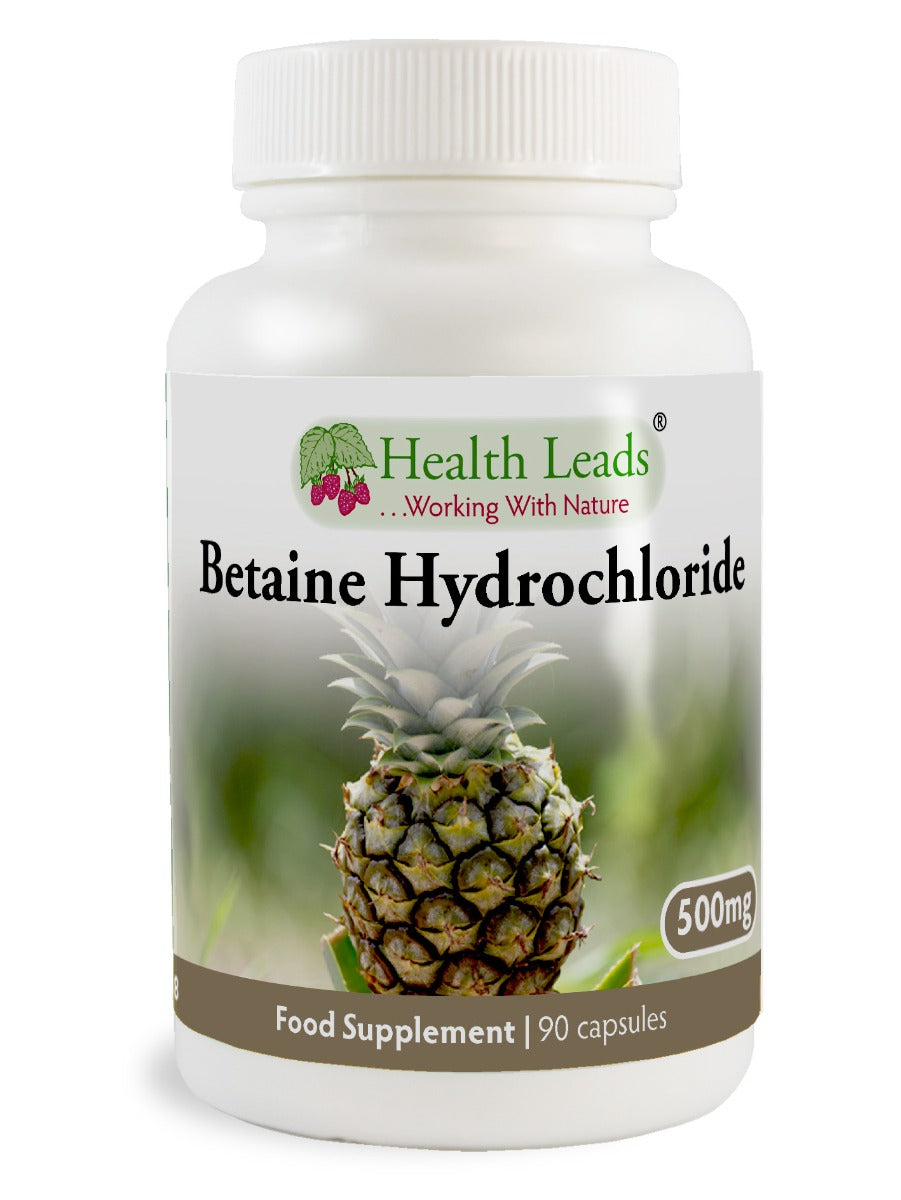
Health Leads Betaine HCl provides 500mg per capsule, with a suggested intake of 1–2 capsules daily with meals. At one capsule per day, a single 90-capsule bottle provides a 90-day supply at £0.13 per capsule — one of the more cost-effective options in the category.
Why Formulation Matters
Betaine HCl is a straightforward compound, but the quality of the supplement it comes in still varies considerably across the market.
Health Leads Betaine HCl 500mg contains:
- Betaine Hydrochloride 500mg
- Rice flour (a small amount used as a capsule filling aid for accurate dosing)
- HPMC vegetable capsule shell (suitable for vegans and vegetarians)
No magnesium stearate. No silicon dioxide. No artificial colours, sweeteners, or flow agents. Made in Wales by Health Leads, ISO accredited, additive-free since 1998.
Rice flour is included in a small amount as a functional filler to ensure consistent capsule filling and accurate dosing — it is not an active ingredient and carries no nutritional claim. We include it on the label because transparency about what's in the capsule is non-negotiable for us.
Betaine HCl and Digestive Enzymes — Should You Take Both?
Betaine HCl addresses gastric acidity. Digestive enzymes — proteases, lipases, amylases — address the enzymatic side of digestion, typically working further down the digestive tract.
For some people, supporting both aspects of digestion simultaneously makes sense, which is why our Multi-Enzyme Complex is commonly paired with Betaine HCl. They address different parts of the digestive process and are not duplicative.
That said, starting with one product and assessing the response before adding another is a sensible approach — particularly with Betaine HCl, where individual tolerance varies.
The Bottom Line
Betaine HCl is not a supplement for everyone — and it's important to be honest about that. For people with conditions involving excess stomach acid or inflammation, it is contraindicated and should not be taken.
For people who have reason to suspect that low stomach acid may be contributing to their digestive difficulties — particularly those experiencing bloating after protein meals, unexplained micronutrient deficiencies, or symptoms that don't improve with conventional antacid approaches — Betaine HCl is a logical, well-understood option worth discussing with a healthcare professional.
If you decide to supplement, the quality of the product matters. An additive-free formulation at an accurate, clearly stated dose is the baseline standard — and one that's straightforward to find if you know what to look for.
Health Leads Betaine HCl 500mg — pure Betaine Hydrochloride in a vegan HPMC capsule. No magnesium stearate, no flow agents, no artificial additives. Made in Wales. ISO accredited. Additive-free since 1998. View product →