

Iron Bisglycinate & Vitamin C: Why the Form of Iron You Take Actually Matters
Iron deficiency is the most common nutritional deficiency worldwide. In the UK, it's particularly prevalent among women of reproductive age, those following plant-based diets, and pregnant women — groups whose requirements are higher and whose dietary sources are often insufficient to meet them.
Most people who start taking an iron supplement know they need iron. Fewer know that the form of iron in the supplement significantly affects how well it's tolerated and how effectively it's absorbed — and that taking it without Vitamin C is leaving a meaningful amount of potential absorption on the table.
This article covers what iron does, why form and absorption matter, what makes Iron Bisglycinate different from standard iron supplements, and why the combination with Vitamin C is more than a marketing addition.
Why Iron Matters
Iron is an essential mineral with a central role in the body's most fundamental processes. It has six EU-approved health claims — a relatively high number for a single nutrient — each reflecting a well-evidenced function:
- Normal formation of red blood cells and haemoglobin — iron is a structural component of haemoglobin, the protein in red blood cells that binds and transports oxygen
- Normal oxygen transport in the body — haemoglobin carries oxygen from the lungs to every tissue and organ; without adequate iron, this transport is compromised
- Normal energy-yielding metabolism — iron is involved in the mitochondrial processes that generate cellular energy
- Reduction of tiredness and fatigue — one of the most recognisable consequences of low iron is persistent fatigue, directly linked to reduced oxygen delivery to tissues
- Normal cognitive function — iron supports neurological function; low iron is associated with impaired concentration and cognitive performance
- Normal function of the immune system — immune cells require iron for normal proliferation and function
Iron deficiency — even without progressing to clinical anaemia — can cause significant symptoms: fatigue, brain fog, poor concentration, reduced exercise tolerance, hair loss, and impaired immune response. Many people experience these symptoms without having had their iron levels checked, or without recognising them as iron-related.

Dietary iron comes in two forms: haem iron from meat and fish (more readily absorbed) and non-haem iron from plant sources (absorption enhanced significantly by Vitamin C).
Why Most People Have Problems with Standard Iron Supplements
If you've taken an iron supplement before and stopped because of digestive side effects — constipation, nausea, stomach cramps, dark stools — you were almost certainly taking ferrous sulphate or ferrous fumarate. These are the forms most commonly prescribed on the NHS and found in mass-market iron supplements, primarily because they're inexpensive.
They're also the forms most associated with gastrointestinal side effects. The mechanism is straightforward: ionic iron forms like ferrous sulphate are harsh on the gut lining, particularly at higher doses. The side effects are common enough that non-compliance with iron supplementation is a recognised clinical problem — people stop taking it because it makes them feel worse.
This is the problem that chelated iron forms — including Iron Bisglycinate — were developed to address.
What Is Iron Bisglycinate and Why Is It Different?
Iron Bisglycinate is a chelated form of iron. "Chelated" means the iron mineral is chemically bound to an organic molecule — in this case, two molecules of glycine, the simplest amino acid. The result is a stable compound where the iron is protected by its glycine bonds.
This changes how the iron interacts with the digestive tract in two important ways:
1. Gentler on the gut. Because the iron is bound to glycine rather than existing as a free ionic mineral, it is less reactive with the gut lining. The mucosa irritation that causes the constipation and nausea associated with ferrous sulphate is significantly reduced. Multiple clinical studies have compared Iron Bisglycinate to ferrous sulphate and consistently found lower rates of gastrointestinal side effects with the chelated form.
2. Good bioavailability. Iron Bisglycinate is absorbed via a different pathway to ionic iron forms — it can use amino acid transporters in the intestinal wall rather than relying solely on iron-specific transporters, which become saturated at higher doses. This supports consistent absorption, particularly at the 20mg elemental iron dose used in this product.
For people who have previously abandoned iron supplementation due to side effects, Iron Bisglycinate is the form most commonly recommended as an alternative worth trying.
Why Vitamin C Is in the Same Capsule
Vitamin C has an EU-authorised health claim specifically for increasing iron absorption. This is not a vague supportive claim — it reflects a well-characterised biochemical mechanism.
Dietary iron exists in two oxidation states: ferric iron (Fe³⁺) and ferrous iron (Fe²⁺). The intestinal iron transporter — DMT1 — can only absorb ferrous iron (Fe²⁺). Vitamin C (ascorbic acid) reduces ferric iron to ferrous iron in the gut, making it available for absorption. It also forms a chelate with iron that keeps it soluble in the intestinal environment, further supporting uptake.
The practical effect: consuming Vitamin C alongside iron meaningfully increases the amount of iron absorbed from the same dose. This is well-established in nutritional research and is the reason why dietary advice for iron deficiency consistently recommends pairing iron-rich foods or supplements with a source of Vitamin C.
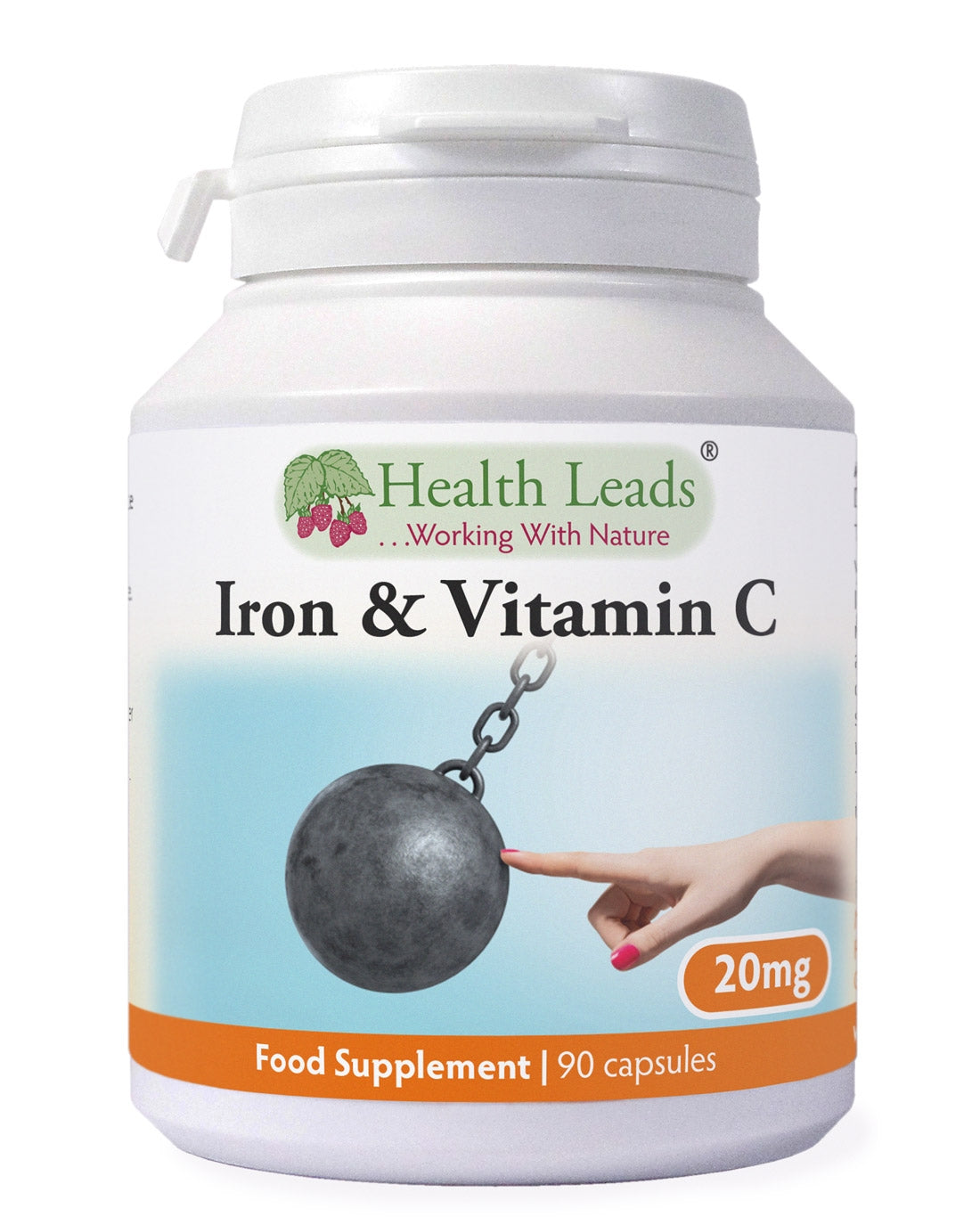
Including Vitamin C in the same capsule as the iron — rather than as a separate supplement taken separately — ensures both are consumed together at the optimal moment. Health Leads Iron & Vitamin C provides 100mg of Vitamin C (as Ascorbic Acid) alongside 20mg of elemental iron from Iron Bisglycinate in a single daily capsule.
Who Is Most Likely to Need an Iron Supplement
Iron requirements vary significantly by age, sex, and life stage. Those at higher risk of inadequate iron status include:
- Women of reproductive age — menstrual blood loss is the most common cause of iron deficiency in women in the UK. Heavy periods significantly increase iron requirements beyond what many diets reliably provide.
- Pregnant women — iron requirements increase substantially during pregnancy to support the developing foetus and expanded maternal blood volume. Pregnancy is one of the most common contexts for prescribed iron supplementation.
- Those following plant-based or vegan diets — plant foods contain only non-haem iron, which is absorbed less efficiently than haem iron from meat and fish. Vitamin C consumption alongside plant iron sources is particularly important.
- Regular blood donors — each donation removes a meaningful amount of iron from the body.
- Athletes, particularly female athletes — intense exercise increases iron losses through sweat, foot-strike haemolysis, and gastrointestinal blood loss.
- Those with gastrointestinal conditions affecting absorption, including coeliac disease and inflammatory bowel disease.
If you suspect iron deficiency, the appropriate first step is a blood test — a GP can check serum ferritin and full blood count. Supplementing without knowing your baseline is reasonable for those in higher-risk groups, but knowing your actual levels allows you to track whether supplementation is working.
What Reduces Iron Absorption — Timing Matters
Iron absorption is significantly affected by what you consume alongside it. This is not a minor consideration — it can substantially reduce the effectiveness of even a well-formulated supplement.
Avoid these within an hour of taking your iron supplement:
- Tea and coffee — tannins bind to iron and form insoluble complexes that cannot be absorbed. This is one of the most significant dietary inhibitors of iron absorption and is particularly relevant in the UK where tea consumption is high.
- Dairy products and other calcium-rich foods — calcium competes with iron for absorption via shared intestinal transporters
- High-phytate foods — wholegrains, legumes, and seeds contain phytic acid which binds non-haem iron; less relevant when taking a supplement away from food, but worth being aware of
- Antacids and proton pump inhibitors — reduce stomach acid, which is needed to release iron from food matrices and reduce ferric iron to the absorbable ferrous form
The Vitamin C in this formula helps counteract some of these inhibitory effects by reducing ferric iron and keeping it in solution, but timing relative to tea and coffee in particular is still worth observing.
An Important Safety Note: Iron and Children
This is not a standard supplement caveat — it is a genuine safety requirement.
Keep iron supplements out of sight and reach of children at all times.
Accidental ingestion of iron supplements by young children is a recognised cause of serious poisoning. Iron overdose in children can be fatal. This product, like all iron-containing supplements, must be stored securely away from children — not just on a high shelf, but in a location where children cannot access them.
What's in Health Leads Iron & Vitamin C
Each capsule contains:
- Iron (from Iron Bisglycinate) — 20mg elemental iron
- Vitamin C (Ascorbic Acid) — 100mg
- Rice flour (small amount as capsule filling aid)
- HPMC vegetable capsule shell
- Other ingredients: None
No magnesium stearate. No artificial colours. No artificial sweeteners. No hydrogenated oils. Suitable for vegetarians and vegans.
Suggested use: 1 capsule daily with food. At this intake, a 90-capsule pack provides a 90-day supply at £0.10 per capsule — one of the more cost-effective iron bisglycinate options in the UK market.
Also available in a 180-capsule pack for those wanting a longer supply.
Commonly taken alongside Vitamin B12 — B12 deficiency shares several symptoms with iron deficiency (fatigue, cognitive changes, weakness) and is also common among those following plant-based diets.
Made in Wales by Health Leads, ISO accredited, additive-free since 1998.
Iron Bisglycinate vs Other Forms at a Glance
| Iron Bisglycinate | Ferrous Sulphate | Ferrous Fumarate | |
|---|---|---|---|
| Form | Chelated (amino acid-bound) | Ionic salt | Ionic salt |
| GI tolerability | Good — significantly gentler | Poor — common side effects | Moderate — better than sulphate |
| Bioavailability | Good | High but poorly tolerated at effective doses | Moderate |
| Constipation risk | Low | High | Moderate |
| Nausea risk | Low | High | Moderate |
| Common in | Quality supplement brands | NHS prescriptions, cheap supplements | Some supplement brands |
The Bottom Line
Iron deficiency is common, particularly among women, those on plant-based diets, and pregnant women. The symptoms — fatigue, brain fog, poor concentration, reduced immunity — are significant and often underattributed to iron status.
The form of iron matters. Iron Bisglycinate offers comparable bioavailability to standard iron forms with substantially better gastrointestinal tolerability — making it the practical choice for anyone who has struggled with conventional iron supplements.
The Vitamin C combination is not a marketing afterthought. It reflects a well-evidenced biochemical relationship that meaningfully improves iron absorption, with an EU health claim to support it. Having both in the same capsule removes the practical barrier of remembering to take them together.
Avoid tea and coffee within an hour either side. Store safely away from children. Take with food. Everything else is straightforward.
Health Leads Iron & Vitamin C — 20mg elemental iron from Iron Bisglycinate with 100mg Vitamin C per capsule. Vegan HPMC capsule. No magnesium stearate, no artificial additives. 90-day supply, £9.85. Made in Wales. ISO accredited. Additive-free since 1998. View product →